

By Taylor Neal
When I ask my cis-het male clients what turns them on in session, almost every single one of them either says, “I don’t know,” or “I get turned on by my partner having a good time.” It's roughly a 50/50 split between the two responses, with the occasional exception of someone who has a very specific kink or fantasy they're already aware of.
Of course, “I don't know” is a common response from women, too. In many cases, not knowing what turns us on points to how so many of us have learned to prioritise performance over pleasure during sex, regardless of gender. Not knowing makes sense in a culture that values function and results over felt sense and embodied experience.
But what I find interestingly distinct about the male experience, from where I sit in clinic, is that men's not knowing what turns them on often seems to extend beyond simply not knowing. Instead, their pleasure becomes outsourced, reliant on their female partner's satisfaction. And this, unsurprisingly, creates a dynamic in which a woman's performance of pleasure can become more important than her actual pleasure. There's often an unspoken fear that her authentic expression — what feels good, what could feel better, what she wants or doesn't want — might somehow mean he is no longer turned on, or that he's no longer doing a good job.
When all the weight of a man's arousal rests on his ability to make his partner feel good, so that he can feel good, everyone ends up performing and no one is particularly present with their own experience. Women learn, often implicitly, that to keep a man happy in bed, they need to appear as though they're having the time of their life. That he needs to feel like he's doing a good job, like he's succeeding at sex, like he's a “real man” (because “real men can get their partner off without fail, or so they say…). And that performance of her pleasure becomes what turns him on.
But why do men need to feel like they're doing a good job to be turned on?
Why are so many men so interested in their partner's pleasure, yet so disconnected from their own?
It can't be a coincidence that so many men seem more interested in, aware of, and sensitive to their partner's pleasure than they are to their own. And if we're going to understand why, we need to look beyond individual sexual dynamics and turn towards masculinity as a cultural construct.
The Man Box: What Men Are Taught About Masculinity
In the late 1970s, a community based initiative called The Oakland Men's Project (OMP) was founded in the Bay Area of California with the intention to engage men and boys in challenging sexism, male violence and the social conditioning that normalised them, inspired by the women's liberation movement and growing recognition of men's violence against women.
Rather than focusing solely on men who had already perpetrated violence, the project used education and prevention workshops to explore how boys learn ideas about masculinity, power, dominance and socially acceptable behaviour that causes harm and perpetuates male loneliness, isolation, and violence.
One of the most impactful concepts to arise from the Project was the Act Like a Man Box, developed in the early 1980s by Paul Kivel and other men central to the group, through workshops in schools. Facilitators asked boys what they believed society expected of men, then mapped those expectations inside a box, and called it the Act Like A Man Box, in recognition that all the traits associated with masculinity are, in fact, a performance.
Common responses in the workshops included being tough, strong, aggressive, heterosexual, emotionally controlled and financially successful. The exercise made visible how masculinity is socially taught and how boys and men are pressured to act like men, still to this day.
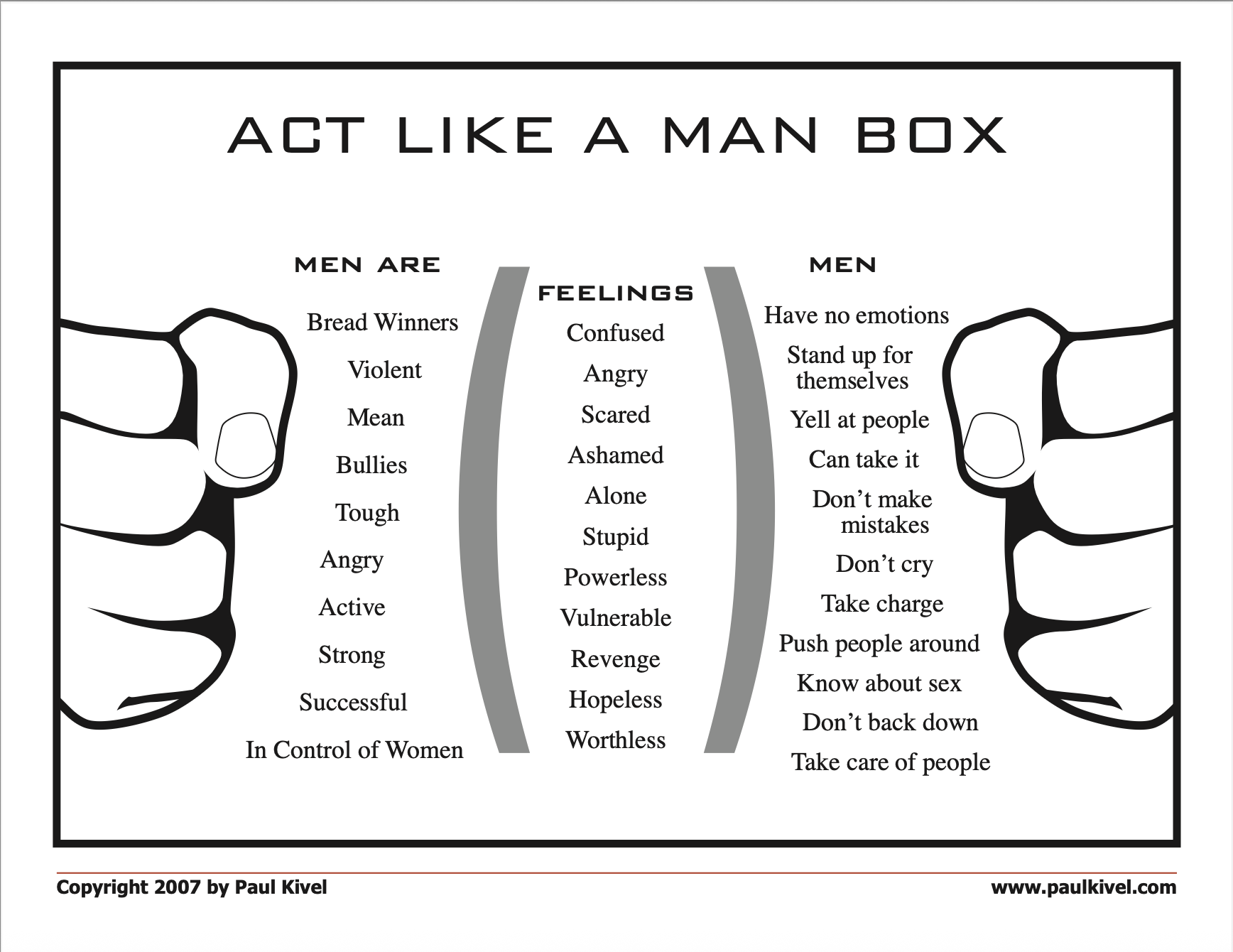
Almost 50 years later, we still see many of the expectations captured by the Act Like a Man Box playing out in conversations about men's mental health, in relationships, in behaviours, and in the social conditioning that surrounds us.
In 2024, Jesuit Social Services published the second edition of The Man Box: Re-examining what it means to be a man in Australia, examining attitudes towards masculinity and behaviours among Australian men aged 18–45. The research found that 36 per cent of men felt socially pressured to conform to traditional Man Box rules, including being strong, not showing vulnerability, always being in control, and being the primary provider at home. Meanwhile, 24 per cent personally agreed with these expectations.
While the majority of men surveyed rejected these beliefs, the fact that so many still felt pressured to perform them speaks to just how deeply these expectations remain embedded in our culture. I'd also argue that consciously rejecting these beliefs is one thing; actively rejecting them through our behaviours, relationships and ways of inhabiting our bodies is an entirely different ballgame. We can intellectually disagree with the expectation that men shouldn't show vulnerability, for example, while still finding it incredibly difficult to be vulnerable ourselves. We can know that these rules are socially constructed and still feel compelled to live by them. If 36 per cent of men are aware enough of these pressures to identify and report them, how many more might be experiencing their effects without recognising them? After all, isn't not showing vulnerability one of the rules? Being impacted by anything sounds pretty vulnerable to me… how vulnerable are men really allowed to be about the ways societal expectations impact them?
But for the sake of the research, let's take these numbers at face value and assume that the majority of men are aware of, and actively rejecting, the societal pressures they feel. How, then, do we explain such widespread disconnection from their own pleasure? Whether consciously or not, if being a man means being self-sufficient, emotionally contained, financially responsible, physically strong, perpetually in control and always the provider, where exactly does that leave room for uncertainty, softness, receptivity, asking for what you need, or simply allowing yourself to feel good without needing to earn it? If your role in the world is to be the provider, how does that impact your ability to receive?
When Being a Provider Becomes Your Identity
When someone becomes more invested in providing pleasure than experiencing it themselves, I wonder whether they've become more comfortable in the role of giving than receiving.
I've been thinking about this through Betty Martin's Wheel of Consent, a framework for understanding the different dynamics within the concept of consent itself, for giving and receiving in relationships.
The Wheel is built around two questions: who is doing the action, and who is it for? From these two questions, we get four quadrants: Serve, Take, Allow and Accept. Each describes a different experience of giving or receiving, and each requires a different relationship with our own desires, boundaries and capacity for pleasure. To understand the wheel, we work to understand what shows up for us, and how it feels for us, to be in each of the different quadrants. This helps us understand our patterns when it comes to consenting, which shows up both in sexual relationships, and pretty much all other relationships we have. As in life, so in bed.
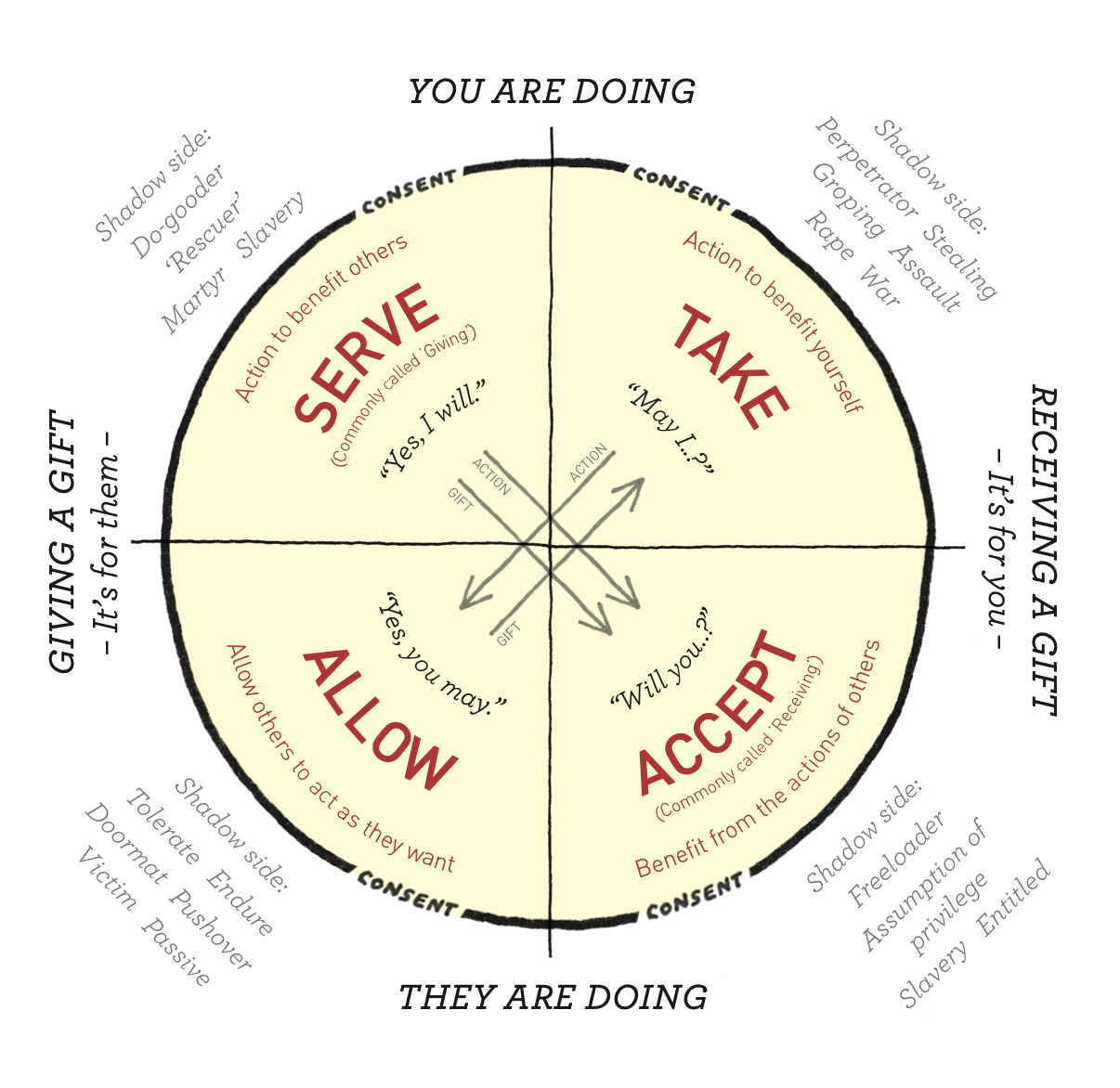
The Accept quadrant is particularly interesting to me in regards to male disconnection from pleasure. In this quadrant, someone else is doing something for your benefit, and you are the one receiving it. You ask for what you want, communicate how you want it, and allow yourself to experience the pleasure of someone else's attention, care or touch. It sounds simple enough, but I wonder how accessible this experience actually is for men who have been conditioned to understand their value through what they provide.
If your sense of masculinity is tied to being capable, useful, strong, self-sufficient and responsible for other people's wellbeing, receiving can feel like unfamiliar territory, and can often actually feel quite uncomfortable, awkward, or unpleasant. I’ve witnessed many men learning this framework actually squirm when told it was their turn to ask for something, and then proceed to take up to 5 minutes to think of something to ask for.
You might be very comfortable taking the lead, initiating sex, giving your partner a massage, making sure they're satisfied, or being the person who knows what to do. You might even genuinely enjoy these things, and I’m definitely not saying every man that enjoys giving is disconnected from their pleasure. But how comfortable are you really, with asking someone to do something for you, with being a burden or an inconvenience, with having needs, desires? How comfortable are you with letting someone else take care of your pleasure without feeling the need to reciprocate, prove yourself or make sure they're enjoying themselves enough to justify receiving?
Masculinity and The Wheel of Consent
I think this is where the distinction between providing pleasure and experiencing pleasure becomes particularly important.
In the Wheel of Consent, Serve is doing something for someone else's pleasure, such as giving your partner a massage or making them a cup of tea, whereas Accept is allowing yourself to receive something for your own pleasure without strings attached, such as receiving a massage or a tea. Neither is inherently better than the other, and healthy sexual relationships have room for both. But if you've learnt that your role is to provide, protect, perform and take responsibility for the experience of others, you might become very practised at Serving while finding it much harder to inhabit Accept.
And this isn't necessarily about being unable to receive touch or enjoy someone else's attention, and it’s not about whether giving all the time is right or wrong. We’re not interested in binaries here. Rather, the wheel and embodied consent as a while, is about whether you can actually stay present with the experience of receiving, rather than turning it into another opportunity to perform, or prove your worth, or rushing to get it over with so you can turn the attention to someone else.
Can you let your partner focus on you without immediately worrying about whether they're enjoying themselves or how you could speed things up? Can you tell them what you want without feeling demanding, selfish or inadequate? Can you receive pleasure without needing to give something back, or without making your partner's good time your central concern?
Most importantly: can you stop worrying about everyone and everything else for long enough to actually take interest in your own pleasure?
When men learn to approach pleasure through the role of provider rather than receiver, their pleasure becomes something they access indirectly, through being good at giving it to someone else.
And when your arousal is so closely tied to your ability to make someone else feel good, to your performance, it can become surprisingly difficult to know what feels good to you when nobody needs anything from you.
Reconnecting With Your Body Beyond Performance
Many men have become so accustomed to understanding their value through what they provide for others, that they lose touch with their capacity to receive, including their capacity to experience their own pleasure.
You might be having lots of sex, and even lots of orgasms, and still be left wondering what the heck you even like beyond what “does the job” or what you know of the sexual script you were given as a teen.
So, what does it actually mean then, to reconnect with your pleasure? Why bother?
I think, first, it requires a shift in how we understand sex in the first place. If you've learnt to approach sex as something you do, rather than something you experience, then reconnecting with pleasure means becoming a little less concerned with what you're doing and a little more interested in what's actually happening inside your body.
Why bother? Would you want to go the rest of your life eating food but not tasting it? No? Interestingly, even though the common response to this would likely be No, many of us eat too fast to taste it anyway. And this is the same thing we’re experiencing when it comes to pleasure. We want to taste our food, and we want to experience pleasure in our bodies because that’s what our bodies are designed to do. So first, we have to take interest in our pleasure, and we do that by shifting our understanding.
There's a difference between being “good at sex” and being connected to your experience of sex.
You can know exactly what to do, how to touch someone, how to get them off, how to maintain an erection, how to last longer, and how to make sure everyone has a good time, while having very little awareness of what you actually enjoy, very little presence in the whole thing. You can be incredibly skilled at the mechanics of sex and still be quite disconnected from the experience of being in your body while it's happening.
And this is where the idea of performance becomes so important. When sex is organised around outcomes — getting an erection, reaching orgasm, making your partner orgasm, lasting a certain amount of time — there's very little room to be curious. You're too busy monitoring whether things are going well to actually notice how things feel. Rather than experiencing arousal, you're managing it or assessing it, which causes your partner to do the same, and then no one’s present in pleasure.
Reconnecting with pleasure asks us to slow down enough to notice what's happening, to become curious about our own sensations, and to allow our experience to be more important than the outcome we're trying to achieve. What feels good? What feels interesting? What am I curious about? What do I want more of? What am I not enjoying? And the scary one, can I let myself change my mind without feeling like a burden to my partner?
For men who have learnt that their value in sex comes from being capable, confident and attentive to someone else's experience, this can require a surprising amount of vulnerability. It means being willing to not know right away, and instead explore. It means asking for something without knowing exactly how it will be received, and asking anyway. It means allowing someone else to take care of you without immediately needing to return the favour, and sitting in the discomfort if it arises. It means letting your partner see you wanting, rather than always doing, providing, tending.
This is an important part of what we mean when we talk about vulnerability in the context of men's pleasure: it's not necessarily about having a big emotional conversation or suddenly becoming comfortable expressing every feeling you have. Sometimes it's much simpler, and perhaps much harder: being able to say what you want and what you don’t want, admit when you don't know, communicate when something doesn't feel good, ask someone to slow down, or allow yourself to receive without feeling that you need to earn it.
Pleasure isn't something you have to be good at. It's an experience for you, that you get to have, too. Perhaps reconnecting with your pleasure begins with allowing yourself to be a participant in sex, rather than always feeling responsible for making it a success.