
I wonder how many men have found themselves in this position: sitting among their friends, hearing a joke about women that makes them uncomfortable, and deciding not to say anything.
Perhaps the person who made the joke is a family member, someone they love or someone who has shown up for them through hard times.They know this person to be funny, loyal and kind in many other ways, but they also know what he just said was sexist. So a mental calculation begins: Is it worth saying anything? Will it change anything? Will he turn on me? Am I just being dramatic?
This is one of the more uncomfortable tensions in conversations about modern masculinity and what change looks like. We ask men to challenge misogyny, but we don’t always make space to talk about what makes that difficult, which at times is the very human desire to belong, the fear of rejection and the complicated reality that people we love can hold beliefs and behave in ways that hurt others.
Understanding this tension is not the same as accepting it as an excuse, but it opens the door to important questions about what kinds of friendships and communities are we building if they can’t hold the weight of conflict or disagreement.
This is when being a good man asks you to disappoint other men, to challenge them and to love each other in such a way that we better each other. When friendship is conditional on being complicit and protecting the bro code, it asks men to sacrifice belonging. No one wants to be the person who ruins the mood or kills the fun, but if ‘the fun’ is predicated on putting women down, I think we should re-evaluate what we consider fun.
Similar messages can be said for how we define loyalty. We often treat loyalty as protecting someone from criticism, standing by them regardless of what they’ve done, or refusing to let others speak poorly about them. So what if loyalty also means being willing to tell a friend when he’s hurting someone?
What if it means refusing to let someone you love become a person who chooses to use violence?
What if the most loving thing you can do is to refuse to participate in the version of masculinity that is making our friends more isolated or more entitled?
My work as a sex therapist offers me the privilege of supporting men who sit in these questions, men who feel deeply and want to do better, and men who worry for their other male friends as much as they worry for the women in their lives. It gives me hope that we’re having these long overdue conversations, but that hope means little without action.
One of the confronting parts about gendered violence is accepting that the people who choose violence are not the scary monsters hiding out in the shadows and they are not a single bad apple in the bunch. Cases like Gisele Pelicot,Jane Doe in the Cornell 2026 case and even our very own once-loved Sam Woodshow us time and time again that these are everyday (and sometimes pedestalled) men causing harm. This includes the men who knew what was going on and still chose to say nothing.
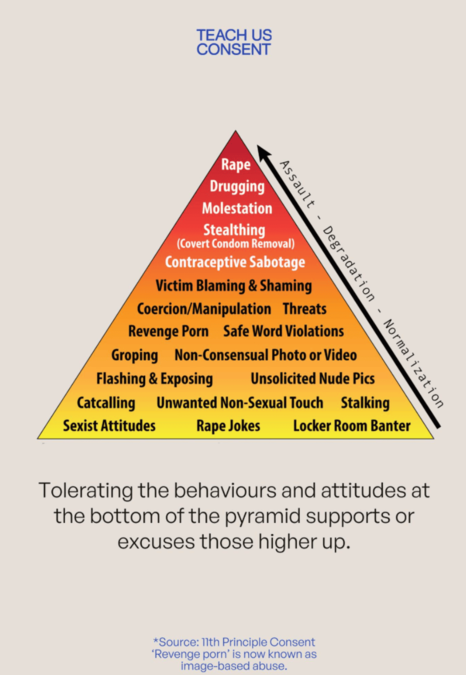
The Rape Culture Pyramid by 11th Principle Consent demonstrates how normalising “smaller” instances of misogyny and sexism create a cumulative effect. To use violence, to post a sexist comment or to violate someone else’s safety are all choices that have been learned and normalised. It is not on the women in our lives to educate and have to protect themselves by taking self-defence classes or not walking alone at night. We all have a responsibility to learn new ways.
Few people respond to the shame of being called out, and instead it can tend to backfire and cause people to dig their heels in or isolate themselves further. If we want to create friendships that can hold accountability and complexity, we might get a lot further by ‘calling people in’ rather than out. This asks us to create space for change and lead by example with curiosity, patience and compassion.
As bell hooks writes, to love someone is to nurture our own and their growth. It is not just something that happens to you, but it is a series of actions and choices that we have to make, especially when it’s uncomfortable or inconvenient. When we want more for the people we care about, it requires us to name when they’re not their best selves or when they’re quite literally causing harm.
I can care deeply for someone and tell them their behaviour was not okay. I can care deeply for someone and not shield them from the consequences of their own actions. I can care deeply for someone and give them space to not be perfect without abandoning them.
What would it look like to create friendships in which men could say to each other:
“I think I handled that badly. Can I talk it through with you?”
“I don’t agree with what he said, but I don’t know how to challenge him.”
“I think I was being defensive because I felt ashamed.”
“I’m worried about becoming the kind of man I grew up around.”
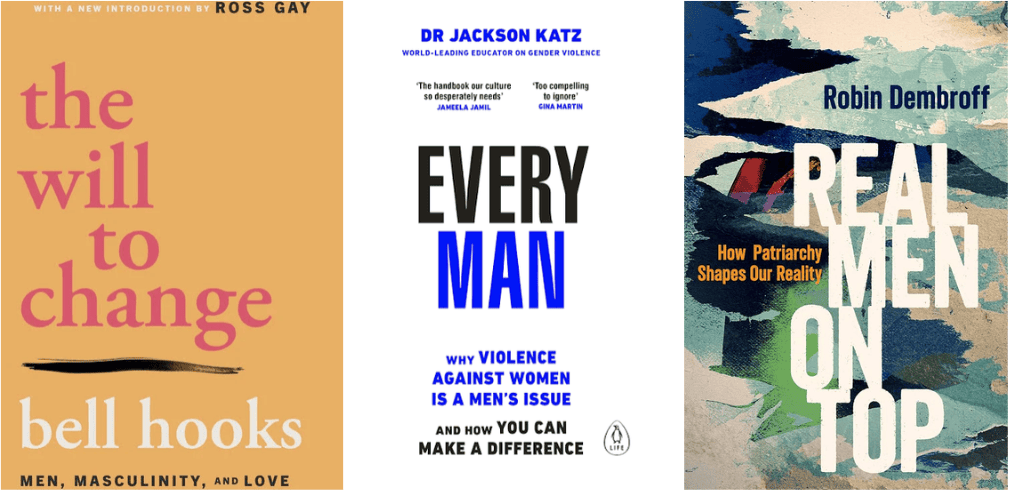
If you’re interested in reading more about this relationship between masculinity and vulnerability, The Will to Change by bell hooks, Every Man by Dr Jackson Katz, or Real Men on Top by Robin Dembroff.
As men, you shouldn’t have to choose between caring about other men and challenging misogyny, but you may have to rethink what caring for other men actually looks like or what it means to be a good friend. Perhaps it looks like checking in with a friend who’s been withdrawing, perhaps it’s letting a friend know they’re not alone when they’re acting out instead of harshly cutting them off, or perhaps it’s starting the conversation about gendered violence.
In this way, what we need is to offer each other space and opportunities to change. Therapy is beneficial in this sense because we are offered a relationship where we don’t have to prove ourselves as capable, strong or always right, but you don’t need to be a trained therapist to offer that to the people in your life.
Very little about change is comfortable and that’s the whole point. It cannot be done alone, and it’s a disservice to ourselves and the people we claim to care about if we see an opportunity for change and then choose to look the other way. We have to move beyond silence and complicity as loyalty, and we have to ask ourselves why is it easier to disappoint a woman than a fellow man?
We talk a lot about the kind of men we want to become, but part of that is also looking at the kind of friendships we are building along the way. We are all so hungry for connection, but have very limited models for intimacy beyond banter, teasing or sacrificing someone else’s safety to feel that we belong. We all deserve more than that.
Resources for folks wanting to learn more about masculinity and gendered violence
Books -
The Will to Change by bell hooks
Real Men on Top by Robin Dembroff
Every Man by Dr. Jackson Katz
She Is Not Your Rehab by Matt Brown
Ten Things I Wish You Knew about Raising Boys by Dr Billy Garvey
See What You Made Me Do by Jess Hill
Fix the System, not The Women by Laura Bates
Why Does He Do That? By Lundy Bancroft
Know My Name by Chanel Miller
A Hymn to Life by Gisele Pelicot
Podcasts -
The Man Enough Podcast
She Matters by Sherele Moody
The Imperfects
How Other Dads Dad with Hamish Blake
Three Percent
Being Well with Forrest Hanson and Dr. Rick Hanson
The Flynn Skidmore Podcast
Rethinking Manhood